Fethullah Gulen Tolerance, Dialogue and Peace
The purpose of this article is to examine educational philosophy of Fethullah Gülen; his perception of realities, challenges, and opportunities surrounding the world of education, his guiding principles currently being practiced in the field of education at every level both in public and private sector.
Fethullah Gülen (2007) considers “… man … the masterpiece of creation”, and wrote that “No profession [-- teaching --] on earth calls for a deeper understanding of human nature, nor for greater skill in guiding it properly” (Cekirdekten Cinara, p.123). Human beings develop both biologically and intellectually by gradually travelling through different stages of life, each with its own requirements for optimal growth.
As Rousseau wrote in his Emile (1972), “Nature would have them children before they are men” (p. 62), and added, “if we try to invert this order we shall produce a forced fruit immature and flavorless, fruit which will be rotten before it’s ripe”. Therefore, human beings cannot be programmed to act in certain ways, but can be educated gradually and incrementally to become better humans (Piaget, 1964). Likewise, Horace Mann, the great nineteenth-century school reformer, confirms that helping children to develop good character is not a quick fix; rather it is a product of a continuous process of intentional teaching and being role models in everyday discourse (Mondale & Patton, 2001). Confirming Horace Mann, Professor Robert E. Slavin wrote, “For a number of years now a character education movement has sought solutions to what many in the public perceive as a decline in the moral character of the nation, in general, and of young people specifically” (Slavin, 2009, p. 54).Theodore Roosevelt once said, “To educate a person in mind and not in morals is to educate a menace in society” (England, 2009, p.4).
The purpose of education
Assessing the philosophical dimension of Gülen’s position as a scholar, in accord with what Rousseau and Piaget once pioneered, Gülen, coming from the school of Sunni, also believes in total child development which promotes social and academic welfare of children concurrently. As for the social fabric of society is concerned, Gülen manifests an inclusive character in his ideology and recommends establishing educational institutions as the true mirror of the society to which the schools are intended to serve.
Throughout his public life, Gülen has taught that learning is a duty for all humans and “by fulfilling it we attain the rank of true humanity and become a beneficial element of society” (Ünal & Williams 2000:308). Gülen is not only addressing the education of children in his writings but the education of all. The participants in the movement see themselves as learning or attempting to learn all the time and the dominant theme of the movement is the struggle for self-improvement.
As for the design and implementation of educational programs, Gülen calls for true public-private partnership inviting all stakeholders, from policy-makers to business people, from school leaders to parents, to active role in planning, implementation and evaluation of educational programs. In addition to a wealth of social capital, Gülen inherited intellectual capital and open-minded worldview based on universal values and global citizenship as the main ingredient. For instance, inspired by Mawlana Rumi who espouses unconditional love for all creatures due to All-Mighty creator in his famous statement; “Come, come to me whoever you are as there is a seat on my heart for you”, he, therefore believes in inclusive approach by which I mean to have an empathy for different worldviews, ideologies and opinions.
Any school or education system anywhere in the world conveys values overtly and covertly, directly and incidentally, deliberately and inadvertently. Given freedom to choose, parents choose schools whose educational philosophy aligns with their own moral values. Some parents may prefer the values of private schools, often out of disagreement with public schools’ official positions on social issues, while others may ascribe a higher quality to them.
Gülen and movement participants are not so disingenuous as to pretend that there is such a thing a value-neutral education system. Gülen’s opinions on the value of education do not differ markedly from the mainstream Muslim view. However, he emphasizes good deeds carried out collectively, and stresses that men and women who cooperate in good works, or meet to discuss the experience and planning of good works are doing a special service (Özdalga 2000:94). Gülen emphasizes the importance of collective consultation and work in his teachings (Gülen 2005:43–58; Sykiainen 2007:126–8) and by example in his personal life (Kalyoncu 2008). This emphasis is reflected in the movement in participants’ use of collective consultation and decision making in educational projects at a local level (Kalyoncu in press:42; Irvine 2007:66, 74–5).
Thus, for Gülen movement participants, when conscientiously performed, education has beneficial effects for individuals and the global community (Ünal and Williams 2000:306). Gülen believes that this approach is advanced by tolerance and patience and not by the suppression of opposition or the use of force. He states, “Improving a community is possible by elevating the coming generations to the rank of humanity, not by obliterating the bad ones” (The Fountain 2002:71).But for Gülen, education is not utilitarian; it is integral to his philosophy and religious world view. This world view is naturally shared by many in Turkey (Kalyoncu 2008)
The Gülen movement originated as a faith-based with a strong cultural identity, but its educational and cultural projects are spreading into regions where world views have neither Turkic nor Islamic roots. Participants and supporters feel they have proved that the high-quality secular education and moral values combined with the altruism of teachers and sponsors are universal values which appeal to people all over the world.
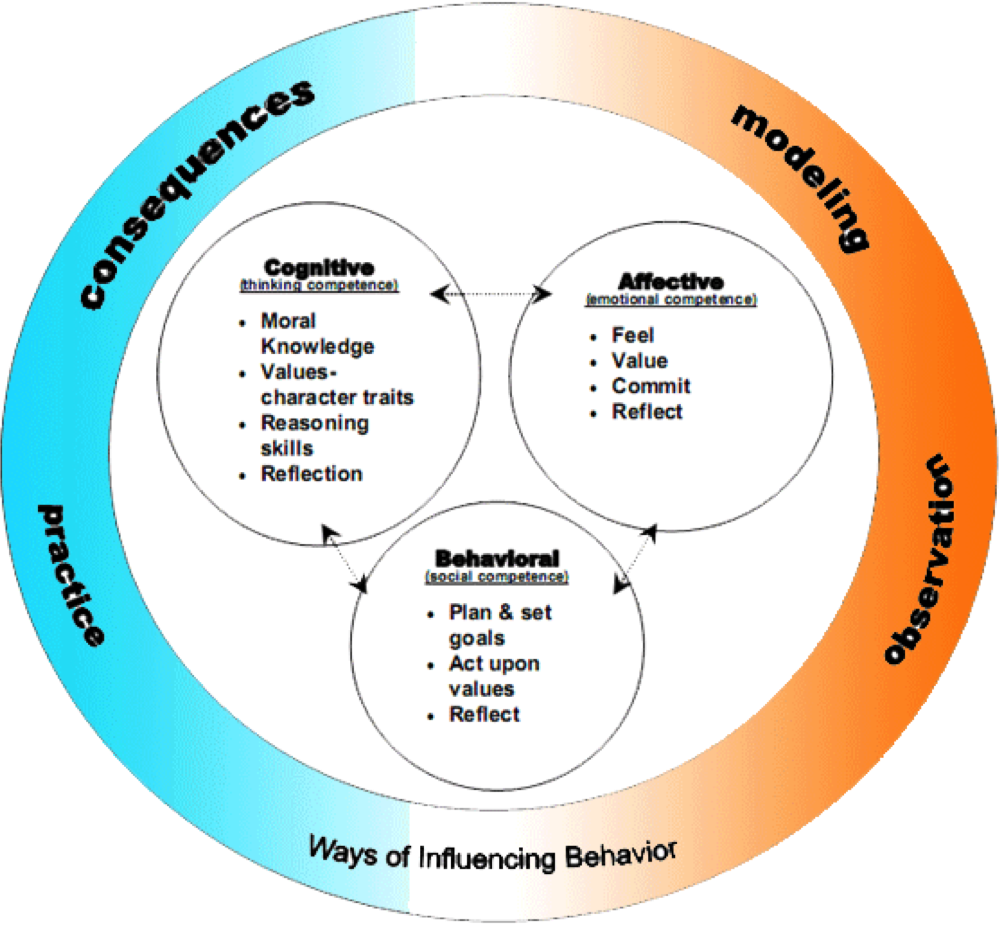
There are number of theories that offer help in grounding Gülen’s educational philosophy. Kohlberg, originally adapted from Piaget’s cognitive development theory, constituted his moral development theory which states that moral reasoning has six identifiable development stages each representing different stages of human development and each is more adequate at responding to moral dilemmas than its predecessor (Steinberg, 2007). The six tenets of this theory are: Stage 1.Obedience and punishment orientation; Stage 2. Individualism and Exchange; Stage 3. Good Interpersonal Relationship; Stage 4. Maintaining Social Order; Stage 5. Social Contract and Individual Rights; Stage 6. Universal Principles. Furthermore, Kohlberg believes that his stages unfold in an invariant sequence which means children always go from stage 1 to stage 2 to stage 3 and so forth, but not necessarily at the same pace (Steinberg, 2007). Kohlberg also argues (Benninga, et al., 2006) that a major moral development occurs especially between the ages of 10 and 12, the middle school years just when the child begins to enter the general stage of formal operations. Furthermore, evidences from developmental neuroscience also support that children enter into psychosocial stage earlier than logical reasoning period and maturate (age 25) later than completing logical reasoning maturation (age 16) (Steinberg, 2007).
Albert Bandura proposed his influential social learning theory arguing that people can learn new information and behaviors by watching other people. The social learning theory advocates that individuals, especially children, imitate or copy modeled behavior from personally observing others, the environment, and the mass media (Jeffery, 1990). Basic tenets of this theory are the following propositions: First is the idea that children can learn through observation. Next is the idea that internal mental states are an essential part of this process. Finally, just because something has been learned, it does not mean that it will result in a change in behavior (Bandura, 1977).
References
Aslandoğan, Yüksel and Muhammed Çetin, 2007 “Gülen’s Educational Paradigm in Thought and Practice”. In Muslim Citizens of the Globalized World: Contributions of the Gülen Movement, ed. Robert A. Hunt and Yüksel A. Aslandoğan, pp. 35–61.
Bandura, A. (1977). Self-efficacy: Toward a unifying theory of behavioral change. Psychological Review, 84, 191-215.
Benninga, J. S. (2010). Character and academics. In Kathleen M. Cauley & Gina M. Pannozzo (Eds.), Educational Psychology (24th ed.) (pp. 2-6). Boston: McGraw-Hill.
Çetin, Muhammed, 2009 The Gülen Movement: Civic Service without Borders. Blue Dome Press
England, T. F. (2009). Character education and the perceived impact on student academic
achievement and in facilitating a safe and effective learning environment in California K-12 public schools. University of La Verne). ProQuest Dissertations and Theses, Retrieved from http://ilsprod.lib.neu.edu/docview/305080932?accountid=12826
Kalyoncu, Mehmet, 2008 A Civilian Response to Ethno-Religious Conflict: The Gülen Movement in Southeast Turkey. New Jersey: The Light, Inc.
Melucci, Alberto,1999 Challenging Codes: Collective Action in the Information Age. Cambridge: Cambridge University Press (First edition 1996).
Nucci, L. (1997). Moral Development and character formation. In H.J. Wahlberg & G.D. Haertel (Eds.), Psychology and Educational Practice. (pp. 127-157). Berkeley: MacCarchan.
Özdalga, Elisabeth, 2003 “Secularizing Trends in Fethullah Gülen’s Movement: Impasse or Opportunity for Further Renewal?”. Critique: Critical Middle Eastern Studies, 12(1), 61–73 (Spring 2003)
Pestalozzi, J. H. (1894). The education of man: Aphorisms. New York: Philosophical Library
Piaget, J. (1965). The moral judgment of the child. The Free Press: New York.
Rousseau, J. J. (1972). Emile (B. Foxley, Trans.). London: Everyman.
Slavin, E. R, (2010). Educational Psychology: theory and practice. New Jersey: Pearson
Education., Inc.
Turiel, E. (1983). The development of social knowledge: Morality and convention. Cambridge,
Mass: Cambridge University Press.
Ünal, Ali & Alphonse Williams, eds. Advocate of Dialogue: Fethullah Gülen. Fairfax, VA: The Fountain.
Weissbourd, R. (2003). Moral teachers, moral students. Education Leadership, 60(6), 6-11.