Fethullah Gulen Tolerance, Dialogue and Peace
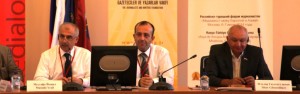 A workshop organized by Journalists and Writers Foundation (JWF/GYV) and the Media Union (Mediasoyuz) was held in Moscow on June 6th, 2014. Prominent Scholar Fethullah Gulen, the honorary president of GYV, attended to the workshop with a letter where he shared his opinions on the future of the media.
Gulen in his letter, first underlines the general inclination towards the ‘speed’ in news consumption and the divergence from in-depth reviews, even in the topics that requires the latter. This preference is a result of our post-modern culture, Gulen says, and adds: It is obvious that this slogan-like approach will reform our decision-making mechanisms and perceptions on the long run. As variety and richness of all world languages have been eroded in the last century, today our youth uses a very primitive language which is composed of only a several hundred words. Gulen concludes his first point in his letter by reminding the responsibility of media in conveying this enrichment to the next generations.
Gulen, states the increasing popularity of ‘new media’ against traditional published newspapers and approaches this ‘inevitable transformation’ as an opportunity to get rid of old bad habits. He lists some wrongdoings of the traditional media and warns about not to fall into the same pitfalls again. As the new media is much more interactive, readers and followers of the new media are also the inspectors of them. If the content quality and new media management is not properly done, then over time inevitably it will turn into an entertainment sector.
A serious problem in the traditional media was that they had to chance to be isolated, Fethullah Gulen notes. Today, in this well networked environment, media should welcome and encourage diversity, co-existence of every religious and cultural groups as they describe ‘the others’ in an ‘acceptable’ way. One of the problems of the traditional media was their lack of information about sensitivities of ‘the others’. So, Gulen emphasizes that the new media should forget ‘the issues of the history’ and work together in peace and harmony by promoting the nice common scenes of our common history.
In the remaining of the letter, Gulen discusses the importance of the media. Media is a power and nobody discusses this, the important point is who controls this with which intentions. Media, as its name suggests -plural of medium- is a tool. It becomes a deadly weapon in the hands of a vicious person, turns into a tool that promotes immoral values in the hands of a pervert, and becomes an elixir in the hands of those who are aware of their social responsibilities. Today, many harmful ideas, worthless speeches and dirty images are disseminated with a great pace thanks to these media and unfortunately gain some supporters. There is a paradoxical life cycle between terrorists and irresponsible news media which have a mindset of “the more blood, the bigger headlines”. The fundamentals of news publishing should have been built upon the principles of ‘keeping the unity of the nation and government’, ‘not to harm the reputation of the government’, ‘not to publish sensational news’, ‘closed to every kind of adultery’, ‘to fight against every wicked thing’ and alike.
After discussing some existential causes of journalism, Gulen moves onto the fundamental principles. Neutrality is a universally accepted principle of the media, as it is also the most violated one. Achieving this requires high character, robust culture, notion of responsibility, and a belief and faith in favoring national interests to everything else. Yet, it is unfortunate that our media gave the wrong answer to the question of ‘whether the media should just reflect/mirror the society or rather guide it?’, and for the sake of circulation rates it has focused on uncovering the wrongdoings of other without caring any personal privacy and has chosen producing all kinds of of gimmicky news, slandering and defamation campaigns.
Gulen, then elaborates more on the relationship between the journalists and the readers. He says: On the other hand, the relationship between journalists and the readers is of course not unidirectional where the former ‘educates’ the latter. Journalists are also a subset of of the community as their journalism culture inherits from the general culture of the society. If a society does not respect the human rights and freedom; if the culture of dialogue and welcoming ‘others’ are not possessed features of the community; if the politicians speak with the language of hatred, so do the journalists are affected by this cultural immaturity. Reformation of one is not independent of the other. From this point of view, not only of the media but also it is the responsibility of the whole community to respect human rights and freedom, support living together in peace, and encourage activities of interfaith and intercultural dialogue.
Fethullah Gulen then touches upon some chronic problems of journalism in Turkey and lists them. There are some other practical problems of our media which is all known by our journalists. Ownership intensity, lack of transparency of ownership, dependency on the advertisements and the relationship with political authorities are some of the obstacles before the freedom of expression. It is saddening to have 29 journalists still imprisoned in Turkey today. What is even worse is that some journalists auto-censor themselves, as they prison their consciences. A journalist can have a free soul and conscience even if his body is imprisoned.
Gulen’s last paragraph is about appreciating the efforts and wishing for the fruitful outcomes. I am sure that the forum of “Media Bridge between Asia-Europe” will discuss these and issues alike, and can find practical solutions that are applicable in our every day life. As a well-respected Turkish scholar had said, nations and even continents talks, just as individuals do. So this enormous dialogue can be maintained via local, national and global media organizations. The fruit of this dialogue to advance the civilizations via a better understanding and appreciation of one another. This resembles to constructive discussion of two intellectuals, where each are enlightened and gain some positive values. So, this international dialogue will produce values that cannot be produced alone, and lead to a jump in the level of civilizations. With this considerations, I congratulate my colleagues organizing “Media Bridge between Asia-Europe”, and hope that your efforts be fruitful and promising.